K. Huang

NYU Shanghai

Kangning (Ken) Huang

Assistant Professor of Environmental Studies

Building a sustainable and resilient urban future through research on urbanization, climate change, and environmental hazards.

About

I am an Assistant Professor of Environmental Studies at NYU Shanghai, where I lead the CLUEs (Climate, Land Use, and Environmental Sustainability) Lab. I received my PhD from Yale University, School of the Environment in 2020, and was an Advanced Study Program Postdoctoral Fellow at the National Center for Atmospheric Research.

My research focuses on how the combination of urbanization and climate change affects vulnerability and adaptability to environmental hazards. By developing global-scale urbanization scenarios, I explore a broad range of possible urban climate futures and the interventions needed to achieve the more sustainable ones.

My work spans urban expansion modeling, urban heat island dynamics, climate adaptation trade-offs, and the scaling laws governing cities. My research has been funded by NASA, NSF, and other sponsors, and featured in Yale News, Scientific American, and E&E News.

Research Areas

UrbanizationExtreme Heat EventsClimate AdaptationRemote SensingGIScience

Research Highlights

Global Urban Expansion Projections

Kangning Huang's research projects that global urban land area will increase by 80–180% by 2050 compared to 2015 levels. This expansion will intensify urban heat islands by 0.5–2°C, affect 1.8 billion additional urban residents, and threaten biodiversity hotspots and agricultural land. Published in Environmental Research Letters (2019), this work has been cited over 480 times.

Urban Heat & Climate Adaptation

Research from the CLUEs Lab demonstrates that nighttime heat stress from urban expansion persists even when heat island mitigation measures reduce daytime temperatures. Additionally, declining urban density can partially offset rising population exposure to surface heat extremes caused by climate warming, revealing important trade-offs in urban planning for climate adaptation.

Urban Scaling Laws

Published in Nature Cities (2025), Kangning Huang's work on nested economies of scale reveals that cities exhibit nonlinear scaling relationships between population and built mass across 3,000+ cities worldwide. These nested scaling patterns provide new insights into how cities grow physically and how urban form relates to resource consumption.

Urban Forests & Environmental Risk

Writing in Nature Climate Change (2022), Kangning Huang analyzed how climate change threatens urban forests — a critical tool for mitigating urban heat islands. His research also addresses 3D urban flood risk by integrating building height and protection standards into global flood risk assessments, revealing how vertical urban development changes flood vulnerability.

Selected Publications

View all →
  • Projects global urban land areas to expand by 0.6–1.3 million km² (78%–171%) between 2015 and 2050 under shared socioeconomic pathways (SSPs)
  • Estimates urban heat island intensification of 0.5–0.7 °C on average, with localized warming reaching up to 3 °C due to urban land-cover change
  • Finds that urban expansion-driven warming can be about half, and in some locations up to two times, as strong as greenhouse gas-induced warming under RCP 4.5
  • Identifies tropical regions in the Southern Hemisphere as facing disproportionately high extreme heat risk from compounding urbanization and climate warming
  • Combines spatially explicit urban expansion modeling at 5-km resolution with mathematical urban heat island models across roughly half of the world's future urban population
urban expansionurban heat islandSSP scenariosglobal urbanization projectionsland-use change modelingWRF climate modelurban land cover 2050
  • Urban expansion through 2050 slightly reduces daytime heat stress (~0.2 °C wet-bulb globe temperature) but intensifies nighttime heat stress by ~1 °C on average and up to 2–3 °C in mega-urban regions of China, India, and Nigeria
  • Approximately half of the nighttime outdoor urban heat stress increase from urban expansion persists even after large-scale deployment of cool roofs as a heat island mitigation strategy
  • Uses WRF simulations with spatially explicit urban land expansion projections and wet-bulb globe temperature (WBGT) as a combined temperature-humidity metric to assess physiological heat stress
  • Demonstrates that infrastructure-based mitigation measures such as cool and green roofs are insufficient alone, highlighting the need for complementary adaptation strategies to address persistent nighttime heat stress
nighttime heat stressurban heat island mitigationurban expansionWRF simulationnocturnal heat exposureclimate and health
  • Proposes a local climate zone (LCZ) land-use change simulation framework that groups ten urban land types into three categories (high-rise, mid-rise, low-rise) for more reliable urbanization simulation
  • Shows that the spatial pattern of occurrence probabilities of grouped urban land types aligns with the economic land price bid curve, linking urban morphology transitions to land market dynamics
  • Validated in the Pearl River Delta metropolitan area, demonstrating applicability to rapidly urbanizing coastal regions where frequent transitions among urban land types alter climate-relevant surface properties
  • Addresses a critical gap in urban climate forecasting by coupling LCZ-based land-use change modeling with meteorological simulation for scenario-based warming projections
urban climate forecastland-use change modelingPearl River DeltaGreater Bay Arearapid urbanizationSLEUTH model
  • News & Views commentary in Nature Climate Change highlighting that more than two-thirds of urban tree species worldwide are projected to face climate risk by 2050
  • Discusses a global assessment of 3,129 species across 164 cities showing cities at low latitudes face the greatest vulnerability, with nearly all urban tree species exceeding climatic safety margins
  • Argues that urban forests are central to climate adaptation and nature-based solutions, yet species selection for urban greening rarely accounts for future climatic conditions
  • Calls for proactive strategies including planting climate-resilient species and adaptive management to sustain the ecological, economic, and public health benefits of urban trees
urban forestsurban trees climate changeurban canopynature-based solutionsclimate adaptationurban cooling
  • Across the 1,000 largest global cities (2003–2020), declining urban population density attenuates the rise in population-weighted surface urban heat island extremes by approximately 0.5 K per decade per 1,000 persons/km²/year decrease in density
  • Cities undergoing densification face disproportionately greater increases in population-weighted exposure to surface heat extremes compared to area-average trends
  • Vegetation changes show a moderate association with population-weighted heat exposure (R² = 0.56), while variations in surface albedo exhibit a negligible relationship (R² = 0.03)
  • Highlights the need for strategic urban planning that balances compact development co-benefits against amplified heat exposure risks in rapidly densifying cities
urban densityheat exposuresurface urban heat islandurban sprawlclimate equitysatellite land-surface temperature
  • Analyzes over 3,000 cities globally to reveal universal sub-linear scaling of built mass with population, with a city-level scaling exponent of β ≈ 0.90 meaning larger cities use less built mass per capita
  • Finds that neighborhood-level scaling exhibits an even smaller exponent (δ ≈ 0.75) than city-level scaling (β ≈ 0.90), demonstrating that economies of scale in built mass intensify at finer spatial resolutions
  • Proposes a theoretical framework showing that city-level sub-linear scaling emerges from the aggregation of within-city neighborhood-level disparities, establishing a nested multi-scale scaling relationship
  • Redefines 'over-built' and 'under-built' conditions as deviations from expected scaling patterns, linking excess built mass to environmental impact and deficient built mass to inadequate living standards
urban scaling lawsZipf's lawcity size distributionbuilt massurban allometryurban economics
  • Uses 1.5 million mobile phone records from 254 urban parks in Tokyo to classify parks by temporal visitation rhythms across daily, weekly, and seasonal scales, challenging traditional static size-based park classification
  • Reveals that park visitation patterns are shaped by user preference variation and accessibility barriers, with parks rhythmized by seasonal events and daily routines such as commuting and exercise
  • Proposes four modes of action for temporal park planning: year-round activity tracing, temporary and tactical designs, inclusive park systems for spatiotemporal equity, and public engagement cultivating a sense of time and identity
  • Demonstrates how temporal insights inform targeted design interventions, such as fitness infrastructure for morning-popular neighborhood parks and extended operating hours for long-evening central parks
urban parkspark planningtemporal classificationurban recreationpublic space designurban planning
  • Applies a difference-in-differences causal framework to 77 demolished informal settlements and 584 control sites across Beijing, Shanghai, and Guangzhou (2002–2022), establishing a clear causal cooling signal of approximately 1.5 K
  • Shows that post-demolition cooling depends on subsequent land use, with greening standards and lower floor-area ratios reinforcing temperature reduction
  • Finds the cooling effect varies by climate context, with stronger thermal benefits in drier cities like Beijing compared to more humid cities
  • Notes the total demolished area across the three cities is only approximately 7.7 km², cautioning that surface temperature reductions cannot be directly equated with health benefits
informal settlementsurban renewalurban coolingdifference-in-differencescausal inferenceslum demolitionGlobal South

Projects

View all →

Nested Scaling of City Mass

Interactive visualization accompanying the paper on nested economies of scale in global city built mass. Explores the nonlinear scaling relationships between urban populations and their built environments across 3,000+ cities.

Urban ScalingInteractive VisualizationNature Cities

Urban Expansion 2050

Projected global urban land expansion through 2050. Based on the research published in Environmental Research Letters (2019), with data available on WRI Resource Watch.

Urban ModelingRemote Sensing

3D Urban Flood Risk

Interactive web app for the paper on integrating building height and protection standards in global flood risk assessment. Visualizes 3D urban flood exposure across cities worldwide.

Flood Risk3D VisualizationInteractive

Urban Renewal Cooling DID

Interactive visualization of key results from the paper on the causal link between informal settlement demolition and urban cooling. Uses a difference-in-differences approach to unveil cooling effects of urban renewal.

Urban CoolingCausal InferenceInteractive Visualization

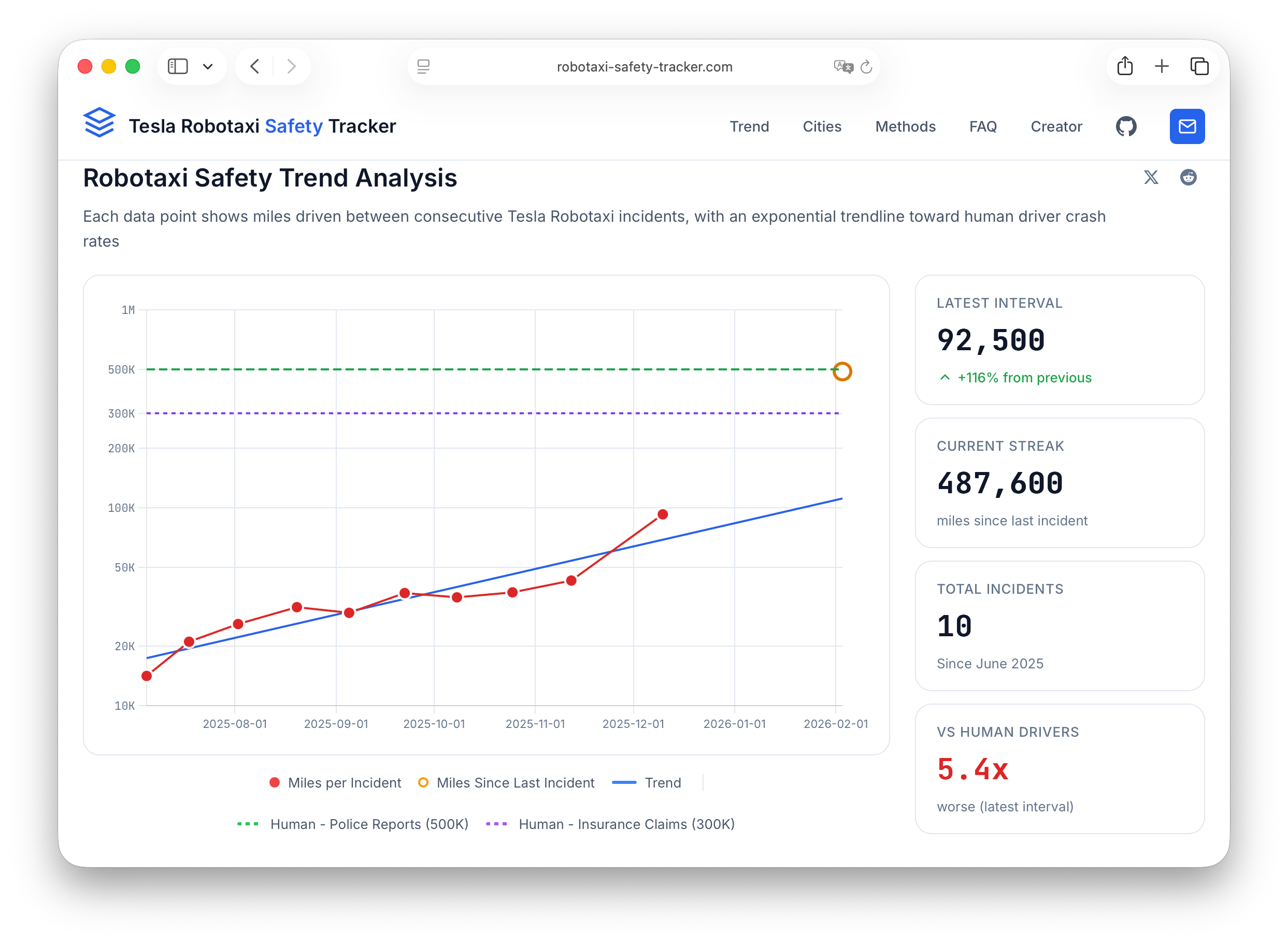
RoboTaxi Safety Tracker

A data-driven dashboard tracking Tesla Cybercab safety performance using NHTSA Standing General Order crash data. Provides transparent, independent analysis of autonomous vehicle safety metrics including miles per incident (MPI) comparisons.

Data VisualizationAutonomous VehiclesSafety Analytics

Polybot Arena

Visualizes how elite trading bots compete in Polymarket crypto prediction markets. Tracks the most profitable traders on Polymarket's 'Up or Down' markets for BTC, ETH, SOL, and XRP, showing their exact timing, positions, and P&L.

Data VisualizationCryptoPrediction Markets

Capitol Alpha

Congressional trading dashboard — track and analyze stock trades made by members of the U.S. Congress.

Data VisualizationFinanceDashboard